One unit for every uninvited guest.
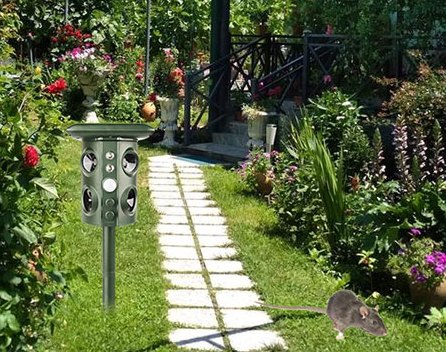
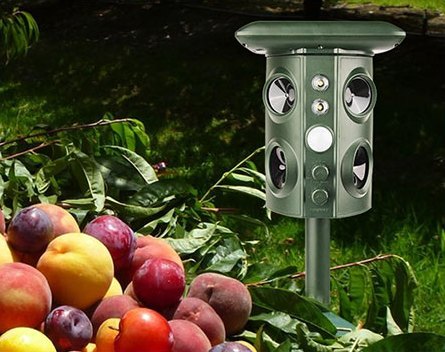
Birds at the fruit, cats in the planters, deer at the hedge, rats in the cables. Ultrasound, strobe light and ground vibration work together so your garden stops feeling safe to them — and they move on.
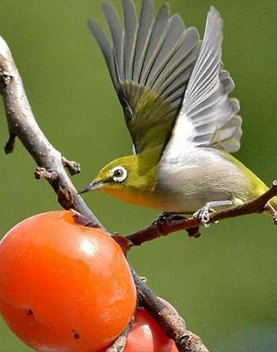 Strobe + sound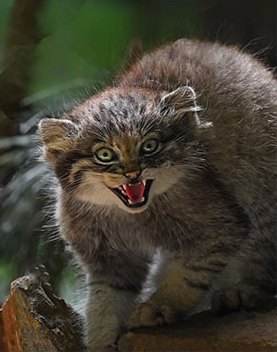

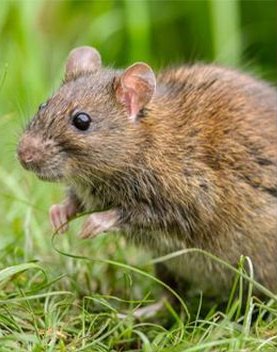


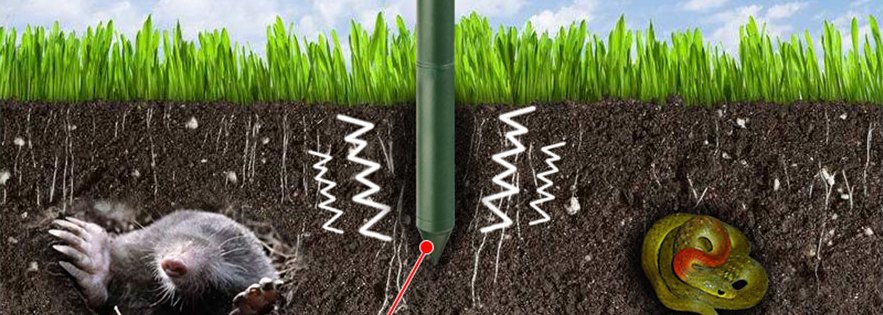 Ground mode
Everything it needs, on one post.
Solar panel on top, sensor and strobes up front, four speakers around the body, and a vibration motor in the stake. No wiring, no app, two dials.
- Ultrasonic drive
- Vibration motor
- LED strobe
- Solar charging
- Infrared sensing
- IP55 weatherproof
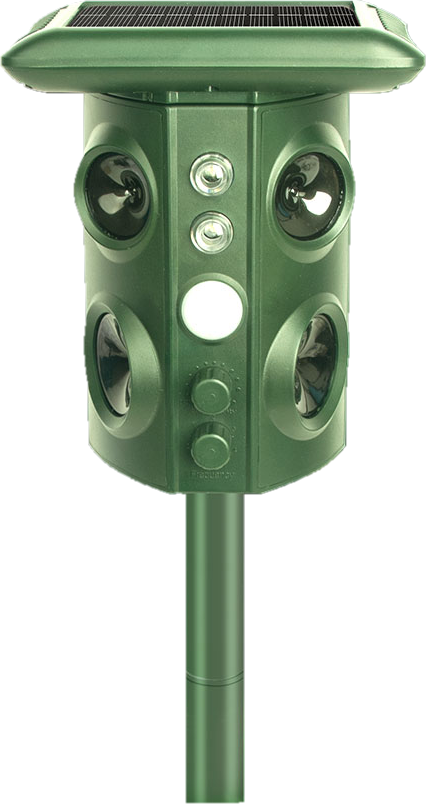
It waits quietly. It works when something arrives.
The unit sits in standby on solar power. Its infrared sensor wakes it only when it picks up body heat, so it isn't sounding day and night.
Detect
A PIR sensor picks up body heat across 110° horizontally and 50° vertically, up to 10 m away. A dial on the front sets the range.
Deter
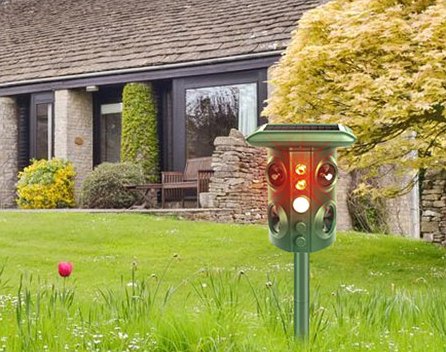
Four speakers emit variable-frequency ultrasound while red and white LEDs strobe, covering about 300 m². A second dial switches the frequency band so animals don't get used to it.
Reach underground
A vibration motor and buzzer in the ground stake pulse through the soil to move snakes and burrowing rodents along.
Reset
Once the area is clear it drops back to standby and keeps charging.
Runs on sunshine. No cables to lay.
The 5 V panel on top charges through the day. On grey weeks, top it up over USB. The batteries are standard AA cells you can swap yourself.

for a full charge
depending on how often it triggers
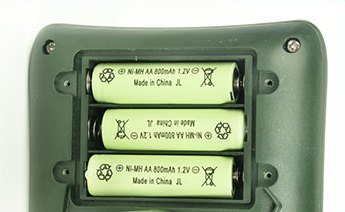
3 × AA, user-replaceable
1.2 V 800 mAh rechargeables. Unscrew the base and swap them — no need to replace the unit.
2-hour USB top-up
USB/DC cable included. Two hours of charge also gives 8–20 days.
Two settings, no app
One dial sets how far the sensor reaches; the other switches the frequency band.
No poison, no traps
Nothing under the hedge for children or pets to find.
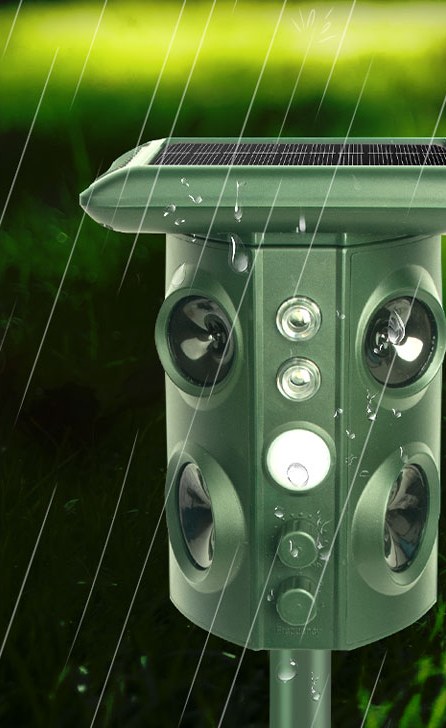
Built to stay out in the rain.
The sealed ABS housing is dust-protected and resists water jets from any direction, so it can stand in the garden through the wet season. Just keep it out of standing water.
- Dust
- Protected (5)
- Water
- Jets from any angle (5)
- Housing
- ABS
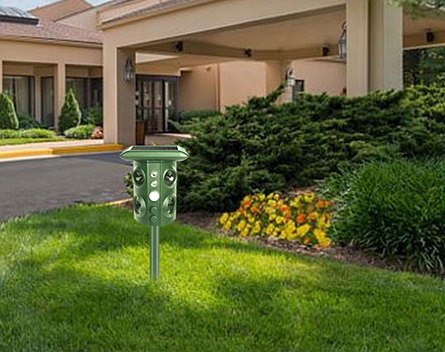
Gardens, villas, orchards and farms.
Push the stake into soil or a planter, face the sensor towards where animals come from, and leave it. Suits villas, parks, farms, paddy fields and orchards.
The details.
| Unit size | 155 × 185 mm |
|---|---|
| Ground stake | 265 mm |
| Weight | 645 g |
| Material | ABS |
| PIR sensor | 110° H / 50° V / up to 10 m, adjustable |
| Ultrasonic coverage | approx. 300 m² |
| Deterrents | Variable-frequency ultrasound ×4 speakers, red/white LED strobe, vibration motor, buzzer |
| Solar panel | 5 V |
| Battery | 3 × AA 1.2 V 800 mAh, replaceable |
| Charging | Solar 13 h or USB 2 h → 8–20 days |
| Protection | IP55 |
| Package size | 160 × 130 × 110 mm |
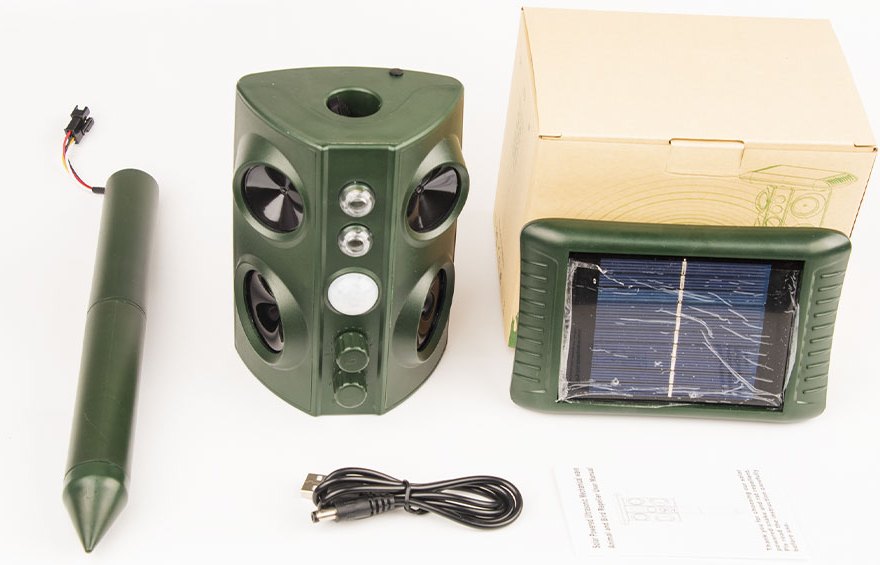
In the box
- Main unit with solar lid×1
- Mounting stake×1
- USB/DC charging cable×1
- Service card×1
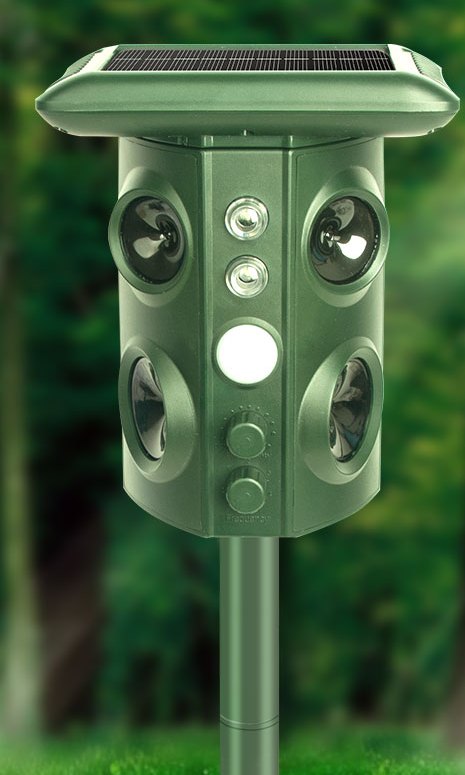
QuietYard solar repeller
Large garden or several entry points? Spread 2–4 units around the edge for fuller coverage.
Before you buy.
Still unsure where to put it? Send us a photo of your garden and we'll suggest a spot.
Message us on WhatsAppWill I hear it?
The ultrasound sits above what most adults can hear (roughly 20 kHz and up). Some frequency settings, children, or people with sensitive hearing may notice a faint sound, and the strobe and ground buzzer are noticeable. Avoid pointing it straight at a bedroom window.
Will it affect my own cat or dog?
Yes — it is designed to deter cats and dogs. Place it where your pets don't usually go, or shorten the sensor range.
Does it work on birds?
Birds react mostly to the LED strobe and sudden sound. Place it near where they land, and change the frequency setting and position from time to time.
What about rain, or a cloudy week?
The housing is rated IP55: dust-protected and resistant to water jets. Don't submerge it or leave it standing in water. During long overcast spells, charge it over USB for two hours.
How soon will I see results?
It depends on the site and the animals. Give it one to two weeks, and move it or switch the frequency now and then so animals don't get used to it.